
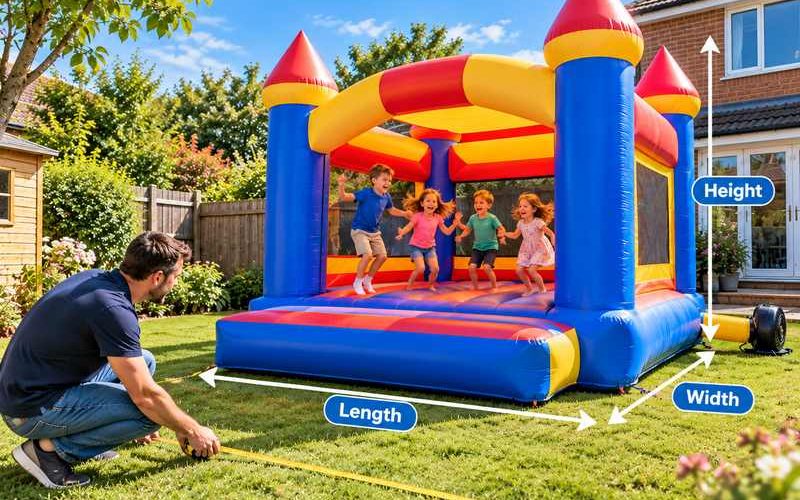
Thinking about hiring a bouncy castle for your garden? Before you book, it’s important to make sure you have enough space—not just for the inflatable itself, but also for safe access, anchoring and the blower.
A few simple measurements can help you avoid problems on the day and make it much easier to choose the right inflatable for your party.
1. Check the Bouncy Castle Dimensions
Start by checking the full dimensions of the bouncy castle you are interested in.
These are usually shown as:
Length × Width × Height
For example:
4.0m long × 3.5m wide × 3.0m high
However, this does not mean a garden measuring exactly 4.0m × 3.5m is large enough.
You will also need additional space around the inflatable for safe installation and operation.
2. Allow Enough Space Around the Inflatable
One of the most common mistakes is comparing the exact size of the castle with the exact size of the available garden space.
A bouncy castle should not be squeezed tightly between fences, walls, sheds or other obstacles.
Extra space may be required for:
- Anchoring points
- Safety mats
- Access around the inflatable
- Safe entry and exit
- The blower and inflation tube
- Inspection during use
The amount of clearance required can vary depending on the inflatable, so always check with the hire company before booking.
3. Check the Available Height
It is easy to focus on the length and width of your garden and forget about height.
Look above the proposed setup area and check for:
- Tree branches
- Washing lines
- Gazebos
- Garden lights
- Telephone or power cables
- Building overhangs
- Low roofs
Some bouncy castles have tall roofs, towers or decorative features that need more overhead clearance than you might expect.
If you are planning an indoor party, ceiling height becomes even more important.
4. Measure the Usable Garden Area
Your total garden size is not always the same as the space actually available for a bouncy castle.
For example, part of the garden may already be taken up by:
- A shed
- Flower beds
- Garden furniture
- Trees
- Play equipment
- Steps
- Raised borders
Measure the clear area where the inflatable will actually be installed.
A simple measurement of the usable:
Length × Width
is usually enough.
If your garden has an unusual shape, take several measurements rather than relying on one overall figure.
Gardens can vary considerably in size and layout, so checking the usable area carefully before booking is always worthwhile.
5. Check the Ground Surface
The type of ground is just as important as the size of the area.
Grass
Grass is one of the most common surfaces for outdoor bouncy castle hire.
The ground should be reasonably level and free from sharp objects, stones or other hazards.
Artificial Grass
Artificial grass needs a little more consideration because standard ground stakes may not always be suitable.
If you have artificial grass, tell the hire company before booking so they can confirm whether the inflatable can be installed safely.
Concrete, Tarmac or Paving
Hard surfaces may require different anchoring methods and additional equipment.
Some hire companies may also charge differently for hard-ground installations.
Never assume that a castle can be installed on every surface in exactly the same way.
6. Look for Slopes and Obstacles
A small slope may not always be a problem, but steep or uneven ground can make installation unsuitable.
Check the area for:
- Steep slopes
- Holes
- Large bumps
- Raised paving
- Steps
- Tree roots
- Garden features
If you are unsure, taking a few photos of the area is often the easiest way to let the hire company assess it.
7. Measure Gates and Access Routes
Even if your garden is large enough, the inflatable still needs to reach it.
Commercial bouncy castles can be heavy and bulky when packed.
Measure any narrow access points, including:
- Side gates
- Alleyways
- Doorways
- Paths between buildings
- Stairways
Also let the hire company know if there are steps, steep slopes or a long distance between the road and the setup area.
A large garden is no help if the inflatable cannot be moved into it.
8. Leave Space for the Blower
Most commercial bouncy castles use an electric blower that runs continuously while the inflatable is in use.
The blower connects to the castle using an inflation tube, so additional space is usually required behind or beside the inflatable.
The blower should not be squeezed between the castle and a wall or placed where guests are likely to walk over cables or equipment.
You should also make sure there is suitable access to electricity.
If the nearest power source is some distance away, speak to the hire company before the event.
9. Move Garden Furniture Before Measuring
Before measuring your garden, decide which items can actually be moved.
These may include:
- Tables
- Chairs
- Barbecues
- Plant pots
- Children’s toys
- Paddling pools
- Small garden equipment
Permanent objects such as sheds, large trees or fixed play equipment should not be included in your available space.
This will give you a much more realistic idea of how much room you actually have.
10. Take Photos Before Booking
Measurements are important, but photos can show things that numbers cannot.
It is useful to take:
- One photo from the house looking toward the garden
- One photo from the opposite end
- A photo of the ground surface
- A photo of the access route or side gate
If there are slopes, trees or unusual obstacles, take photos of those as well.
This makes it much easier for the hire company to recommend a suitable inflatable.
How Much Space Do You Need for a Bouncy Castle?
There is no single answer because bouncy castles come in many different sizes.
A small children’s castle may fit comfortably in a modest garden, while a larger castle with a slide or obstacle section will need considerably more room.
The best approach is simple:
Measure your available space first, then choose the inflatable.
If your garden is small, give the hire company your maximum available:
Length × Width × Height
They can then suggest suitable options.
What If Your Garden Is Too Small?
A small garden does not necessarily mean you cannot hire an inflatable.
You may still be able to choose:
- A smaller bouncy castle
- A low-height inflatable
- A compact bouncy castle with slide
- A smaller inflatable game
- An indoor inflatable
- A local hall or community venue
It is usually better to choose a slightly smaller inflatable with comfortable clearance than to try to squeeze a larger castle into a restricted area.
Quick Bouncy Castle Garden Checklist
Before booking, check:
- The inflatable’s length, width and height
- Available garden length and width
- Overhead clearance
- Ground surface
- Slopes or uneven areas
- Space for anchoring
- Space for the blower
- Gate and access width
- Nearby fences, trees and buildings
- Electrical access
- Permanent garden obstacles
Taking a few minutes to check these details can prevent delays or disappointment on the day of your party.
Final Thoughts
Measuring your garden properly before booking a bouncy castle can save a lot of unnecessary problems on the day.
Check the available length, width and height, allow enough room around the inflatable, and don’t forget about access, ground conditions and the blower.
A few simple measurements in advance can make it much easier to choose a bouncy castle that fits your space and can be set up safely.