
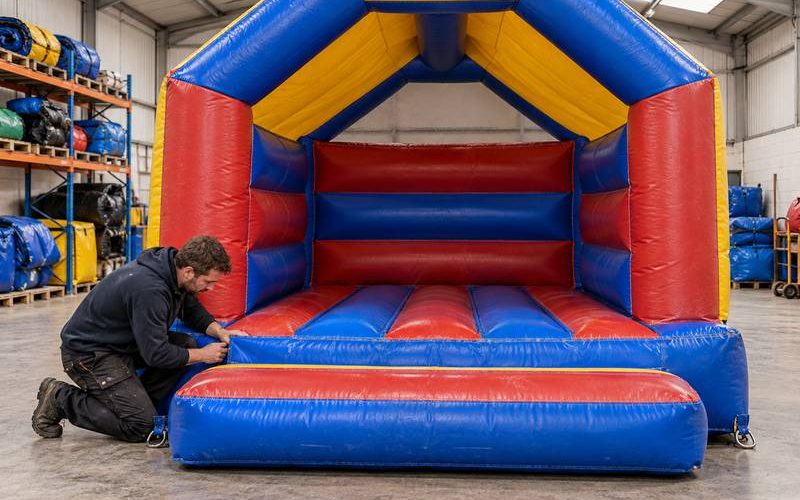
Repeated repairs, structural problems and equipment that no longer suits your customers can all be signs that a commercial bouncy castle needs replacing. Before making that decision, assess its condition, repair options and usefulness to your hire business rather than relying on age alone.
A well-maintained castle may remain useful for years, while another may need replacing sooner because of heavy use, damage or changing booking demand. Some issues require immediate withdrawal from service; others give you time to plan a replacement.
Here are five signs to look for, along with practical steps to help you decide whether to repair, refurbish or replace your inflatable.
1. Damage Is Affecting Safety-Critical Parts
Damage to anchoring points, structural seams, containment walls or entrance areas needs more attention than faded artwork.
During your checks, look for stitching pulling away, reinforcement separating from the surrounding fabric, damaged mesh or tears around attachment points. Record the location and extent of each problem, and take clear photographs for the manufacturer or a competent repair specialist.
Do not assume a patch is suitable simply because it covers the visible opening. The appropriate repair depends on the material, location and function of the affected part.
If a defect could affect safe operation, take the inflatable out of service until it has been assessed and addressed. Replacement becomes necessary where a competent assessment finds that a suitable repair cannot restore it to a safe condition.
Keep inspection reports and repair records together. They help establish whether a problem is isolated or part of a recurring pattern, and give the person assessing the equipment useful background.
2. The Castle No Longer Maintains Its Intended Shape
A castle that appears softer than usual, develops distorted walls or no longer holds its intended shape needs investigation before another hire.
The inflatable itself may not be the only cause. Blower problems, an obstructed air inlet, an incorrectly secured inflation tube or open deflation closures can also affect inflation.
Establish the cause using the manufacturer’s instructions and competent assistance where needed. Do not try to compensate by fitting a different blower without confirming that it is appropriate for the equipment.
If the investigation identifies fabric deterioration or internal structural damage, ask what repair options are available. A blower fault may be resolved without replacing the castle, while deterioration across several parts of the inflatable may make replacement more practical.
Photographs taken from the same angles over time can help document changes. However, photographs alone cannot establish whether operating pressure or structural condition is acceptable.
The important question is whether the equipment can be restored to its intended operating condition through an appropriate repair.
3. Repairs and Downtime Are Becoming a Pattern
A single repair does not necessarily mean a castle has reached the end of its useful service. Repeated problems are a stronger reason to review it.
Track more than the repair invoices. Record transport to the repairer, time unavailable, cancelled bookings and the work needed to arrange substitute equipment.
For example, three repairs costing £120 each total £360. If the downtime also prevents two bookings that would each have contributed £70 after direct costs, the combined repair cost and lost contribution is £500.
These figures are illustrative, but the calculation helps reveal costs that are easy to overlook. Use lost contribution rather than the full booking price, because some delivery, labour and other direct costs may not have been incurred.
Compare the repair history with the total delivered cost of a replacement, its likely demand and its handling requirements. A new castle is an investment, so avoid assuming it will immediately attract more bookings.
There is no universal repair-cost percentage that makes replacement the right choice. Safety findings come first. For equipment that remains suitable for use, consider the reliability of previous repairs, expected future costs and the contribution it makes to your business.
4. Its Presentation Is Hurting Bookings
A structurally sound castle may still become less attractive to customers if it looks heavily worn.
Faded colours, marked artwork and conspicuous repairs can make it harder to produce appealing product photographs. Before replacing it, establish whether appropriate cleaning or a manufacturer-approved refurbishment could improve its appearance.
Compare recent photographs with older images. Your website should show what customers will receive, rather than relying on pictures taken when the equipment was new.
Look for evidence that presentation is affecting demand. Do customers mention its condition? Do they regularly choose a comparable unit at the same price? Has interest in its theme declined?
Low bookings alone do not prove the castle needs replacing. Pricing, photographs, availability and how prominently it appears on your website can also influence enquiries.
Cosmetic wear does not establish that an inflatable is unsafe, and an attractive exterior does not establish that it is safe. Assess appearance and structural condition separately.
Where refurbishment offers limited improvement and customer demand has declined, replacement may be a reasonable commercial decision.
5. The Equipment No Longer Fits Your Customers or Delivery Work
Sometimes a castle needs replacing because your business has changed.
You may receive more indoor enquiries, yet your existing unit is too tall for the halls customers choose. Its packed size, weight or handling requirements may also make certain deliveries difficult or unprofitable.
Record the enquiries you cannot fulfil and the reasons. Repeated requests for a lower-height castle provide stronger evidence than a general impression that indoor equipment might be popular.
Before selecting a replacement, check:
- Overall dimensions and required setup space
- Intended users and operating limits
- Packed size, weight and handling requirements
- Specified blower and electrical requirements
- Documentation and inspection arrangements
- Total delivered cost and expected availability
Before ordering from a manufacturer such as East Inflatables, confirm the replacement’s overall dimensions, packed weight and blower requirements. Compare these with the venues you regularly serve and the space available in your vehicle to avoid buying a castle that creates the same practical difficulties as the old one.
For indoor hires, consider the usable space around the inflatable as well as its overall dimensions. Ceiling fittings, entrances and access routes can affect whether a unit is suitable for a particular venue.
A replacement should solve a documented problem. Buying a larger or more elaborate castle will offer little benefit if it creates the same access difficulties or does not match the enquiries you receive.
Should You Repair, Refurbish or Replace?
Start with the equipment’s condition. Where safety is in doubt, remove it from use and obtain competent advice before accepting another booking for that unit.
If an appropriate repair is possible, request a clear description of the work, its cost, expected downtime and any checks needed before the castle returns to service.
If the issue is mainly appearance, compare the cost of refurbishment with the improvement it is likely to deliver. Consider how long you expect to keep the equipment and whether customers still want that size and theme.
If the castle no longer fits your bookings or delivery work, use enquiry records and completed-hire costs to define what a replacement needs to do better.
Keep the existing unit’s specifications, inspection reports and repair history together. These records provide a stronger basis for your decision than age or appearance alone.
Plan the Replacement Before Promising It to Customers
Allow time for production, delivery and the checks needed before new equipment enters service. An estimated arrival date alone is not enough to promise a replacement castle for a customer’s event.
Once the new unit is ready, update your product photographs, dimensions and booking information. If an existing booking requires different equipment, explain the proposed change and obtain the customer’s agreement.
Review any future bookings for the outgoing castle before removing it from your range. This helps you arrange suitable alternatives and avoid last-minute disruption.
The best replacement is one that meets a clear business need: suitable dimensions, manageable handling, reliable availability and a design your customers want to hire.